日誌ARCELF

Fragments of Beauty from a Kyoto Nishijin Tsumekaki Hon-Tsuzure Ori Workshop

京都・西陣爪掻本綴織の工房で見つけた、美しさの断片

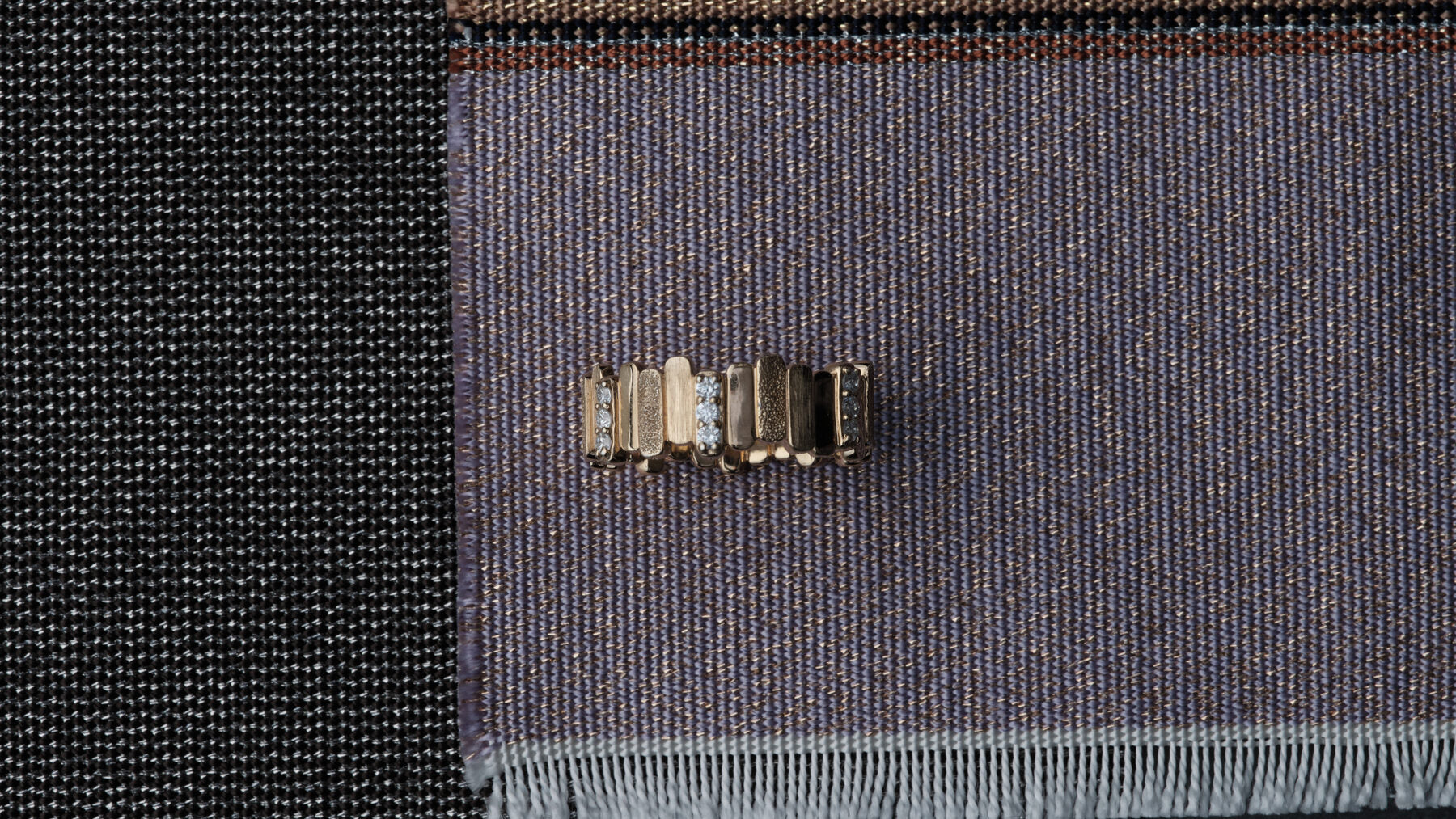
The first ARCELF collection was born from Nishijin tsumekaki hon-tsuzure-ori (nail-scratching tapestry weaving), a traditional craft of Nishijin, Kyoto.


Having been born and raised in Kyoto, textiles have been a familiar presence to me since childhood. That's why I wanted to start my first collection with textiles. And I wanted that beginning to be in my hometown, Kyoto.


With that thought in mind, I visited Soushi Tsuzureen, a workshop of Nishijin tsumekaki hon-tsuzure-ori.

Weaving thread by thread by hand, using fingernails as tools


Nishijin tsumekaki hon-tsuzure-ori is one of the most exquisite techniques among Nishijin-ori.


Artisans file their fingernails, carving them into fine, serrated edges.

Using these fingernails as tools, they weave thread by thread, drawing in the weft threads.
All done by the artisan's eyes, hands, and intuition.

The threads Mr. Hirano showed me were so fine it was difficult even to pick them up with my fingertips. More than 140 of these threads are passed through a mere 3-centimeter width. For colors, they use over 4,500 different shades, blending more than 100 threads by hand, one by one, to create new colors.


It is a job that requires an immense amount of time and concentration.


What was particularly striking was that the pattern on the front cannot be seen until the tapestry is completed. Artisans weave the piece face down, occasionally checking the surface by reflecting it in a mirror.

Accumulating layer upon layer, trusting the final form without seeing it.


Perhaps that is what craftsmanship truly is.

The answers aren't immediately visible; you build step by step, believing in an unseen future. Standing before the tapestry loom, I felt as if I had touched the essence of this craft.

Kikuo Hirano, who has dedicated 70 years to tapestry weaving


Kikuo Hirano, who I spoke with at the workshop, is an artisan who has been involved in tapestry weaving since he was 15 years old.
He has walked alongside this technique for 70 years.


"After about 10 years, you get pretty good at weaving. But it takes about 40 years to really understand how to weave."

In his youth, feeling the limitations of his family's obi weaving business, he ventured into a large company. He entered that world with the desire to "create better things" and "expand the scope of expression," but there was another reality there.


"Even if I wove the same thing I wove three years ago, the price would be lower. That was certainly frustrating."


As skills improve, work becomes faster. But the value is not always properly recognized. He spent about 50 years at that company, repeatedly struggling with such contradictions.


After retirement, Mr. Hirano established the workshop "Soushi Tsuzureen."


"If I didn't, I felt it would disappear."

"Initially, I strongly wanted to preserve it as an industry. But the reality is quite challenging. Even if people are trained, they become independent, and it's a world where artisans can't continue on minimum wage. Because I've seen that reality, now rather than preserving it as an industry, I want to enjoy this technique itself and preserve it in various forms."


At the workshop, there were high school students who continued coming even as university students, and housewives.
Mr. Hirano said he deliberately assigns them difficult tasks.

"I have them do difficult things from the start. Once they succeed at one thing, they make a big leap in skill."


Rather than repeating simple tasks, significant growth comes from overcoming a higher hurdle. This way of thinking also reflected Mr. Hirano's unique approach, having dedicated 70 years to tapestry weaving.

And what Mr. Hirano enjoys most, he says, is surprising people.


"The most interesting thing is showing my chosen way of expression and enjoying people's surprise. 'Wow, you can do that!' is the sound I want to hear most."


Even now, nearing 90, Mr. Hirano continues to work in his workshop every day.


"My greatest wish is to enjoy myself and convey that joy to others. I'm now thinking I'll do this until I die. I truly feel fortunate to have encountered something in my life that makes me feel that way."


Leaving the workshop, I kept repeating those words to myself.

I was deeply moved by the weight of what he had accumulated over 70 years, and by his unwavering forward-looking attitude.