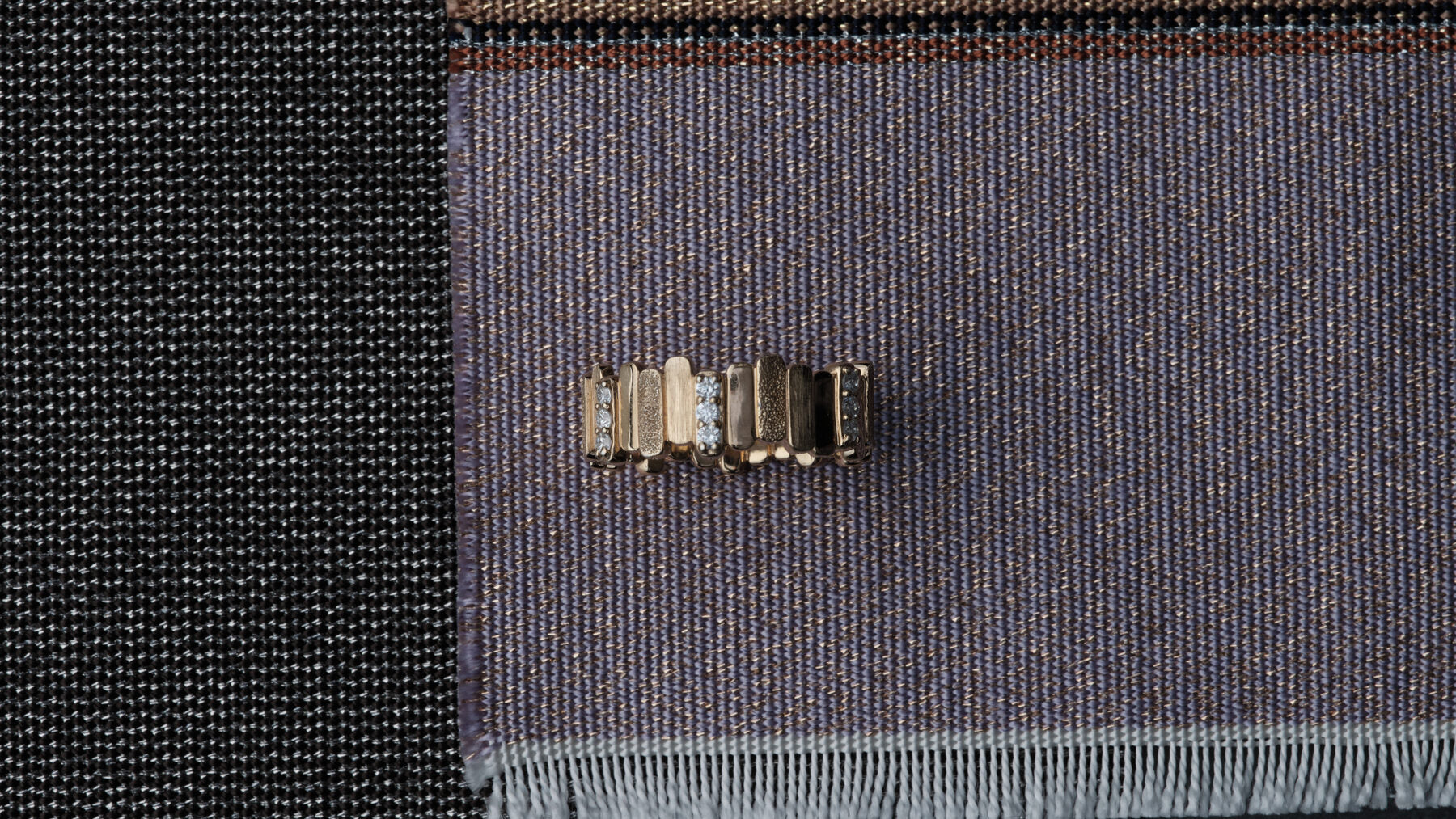
ARCELF’s first collection was born from Nishijin Tsuzure, a traditional weaving technique from Kyoto known as Nishijin Tsumekaki Hon Tsuzure.
Having grown up in Kyoto, textiles were always part of my everyday life.
From the very beginning, I knew I wanted ARCELF’s first collection to begin with weaving.
And I wanted that beginning to be rooted in my hometown.
That journey led me to Soushi Tsuzure-en, a workshop dedicated to the art of Nishijin Tsumekaki Hon Tsuzure.
Weaving One Thread at a Time, Using the Fingernails as Tools
Nishijin Tsumekaki Hon Tsuzure is considered one of the most sophisticated techniques within Nishijin weaving.
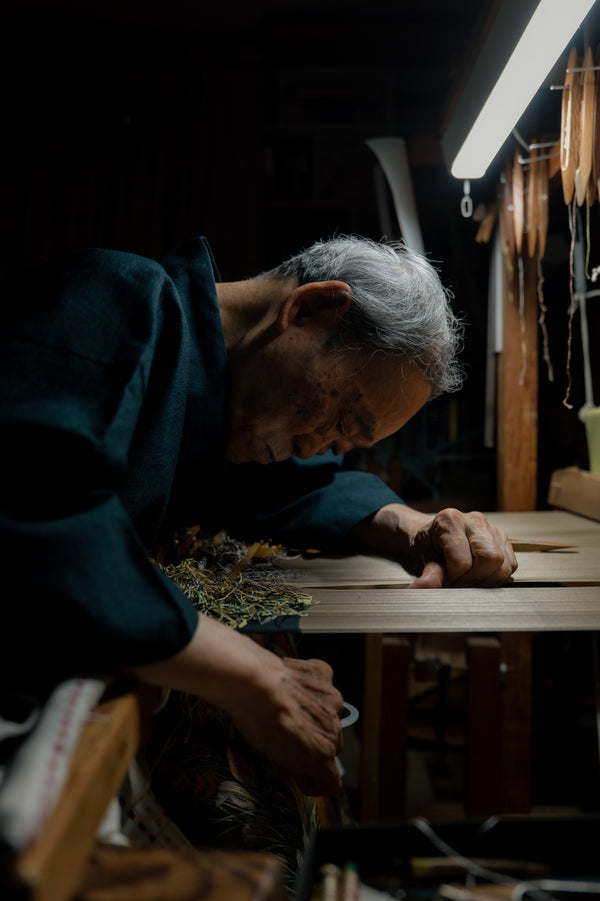
Artisans file their own fingernails into fine serrated edges and use them as tools, pulling each weft thread into place by hand.
Every thread is guided by the artisan’s eyes, hands, and intuition.

The threads Mr. Hirano showed me were so fine they were difficult to grasp even with my fingertips. More than 140 threads are woven into a width of just three centimeters. Some works require over 4,500 different colors, created by carefully combining and adjusting more than a hundred individual threads by hand.
It is a practice that demands extraordinary patience, concentration, and time.
What fascinated me most was that the final image remains invisible throughout the weaving process.
The work is woven from the reverse side. Artisans periodically use a mirror to glimpse the front, checking their progress only through reflection.

Trusting in a finished form that cannot yet be seen.
Standing before the loom, I felt that perhaps this is the essence of making anything meaningful.
The answer does not appear immediately.
One continues, step by step, believing in something that exists only in the future.
Seventy Years Devoted to Tsuzure
The artisan who welcomed me into the workshop was Kikuo Hirano.
He has devoted more than seventy years of his life to Tsuzure weaving, having begun at the age of fifteen.
“After about ten years, you can weave reasonably well. But understanding how to weave—that takes about forty.”
In that brief sentence, I felt the weight of a lifetime devoted to the craft.

When he was younger, Hirano felt limited by his family’s traditional obi-making business and joined a larger company instead.
He wanted to create better work.
To expand the possibilities of expression.
Yet another reality awaited him there.
“Even if I wove exactly the same piece I made three years earlier, the price would sometimes be lower. That always bothered me.”
As his skills improved, his work became faster and more refined. Yet greater mastery did not always mean greater value. He spent nearly fifty years navigating those contradictions before eventually retiring and founding his own workshop, Soushi Tsuzure-en.
“If I hadn’t done it, I felt it might disappear.”
At first, his goal was clear.
 “I wanted to preserve it as an industry. But the reality is difficult. People learn and eventually leave. It’s also a world where artisans can’t survive on minimum wage. After seeing that reality for so many years, I’ve come to think less about preserving it as an industry and more about preserving the technique itself—finding different ways to keep it alive while enjoying it.”
In the workshop were people from many walks of life: a university student who had been coming since high school, homemakers, and others drawn to the craft.
Hirano deliberately gives them difficult challenges.
“I start them with something hard. Once they get through one, they suddenly become much better.”
Rather than repeating simple tasks, he believes growth comes from overcoming obstacles just beyond one’s reach.
Even after seventy years, he remains driven by curiosity.
“The most enjoyable thing is showing people a new way of expressing something and seeing their reaction. I love hearing people say, ‘Wow, I didn’t know that was possible.’”
 Today, approaching the age of ninety, Hirano still comes to the workshop every day.
“My greatest wish is to enjoy what I do and pass that enjoyment on to others. At this point, I think I’ll keep doing this until the day I die. To have found something I could dedicate my entire life to—that’s a real blessing.”
As I left the workshop, those words stayed with me.
The weight of seventy years devoted to a single craft.
And the determination to keep moving forward, even now.